

Lesson 1400: Summary and Improvement Strategies for Narcolepsy

Duration:70 minutes
Topic Introduction:The most important thing to consider for narcolepsy is safety in daily life, especially in situations involving driving, operating equipment, climbing, caring for others, or going out alone. This section helps you identify high-risk tasks and set up alarm, companion, alternative, and help mechanisms to prioritize your safety. May you gradually see what your body truly needs. Please observe gently first, without rushing to blame yourself. Every record you keep will help you get closer to the answer.
○ Course Topic Audio
Lesson 1400: Summary and Improvement Strategies for Narcolepsy
Click to view the read-aloud text
In this section, please set aside blame. Recurring daytime drowsiness, difficulty waking up, and short attention spans often lead to shame, but shame doesn't solve the problem. We need to recognize our body's signals, sleep patterns, safety risks, and where to seek help. This section focuses on "Life Safety Risks of Narcolepsy." Life safety is paramount for those with narcolepsy. Driving, operating equipment, climbing, using fire, caring for others, or going out alone can all become dangerous due to sudden drowsiness. This isn't about labeling you as having a problem, but about helping you move away from vagueness, self-blame, and forcing yourself to a position where drowsiness can be observed, discussed, and improved. When learning, begin with specific record-keeping. Identify your high-risk scenarios and set up warning, escort, alternative transportation, or suspension mechanisms in advance. Simply saying "I'm sleepy" makes it difficult to find direction; recording the time, scenario, physical reactions, and safety risks will make subsequent assessments much clearer. Next, choose a small and safe action. Protecting your safety is not weakness, but responsibility for yourself and others. Change doesn't have to be done all at once, especially when excessive sleepiness is impacting your life. First, reduce the risks, then gradually adjust your rhythm, tasks, and methods of seeking help. Course content cannot replace assessments by doctors, sleep specialists, or mental health professionals. If you experience sudden sleepiness, driving risks, severe functional impairment, or significant mood swings, please seek in-person professional support as soon as possible. Don't expect to become alert immediately by the end of this session. Start with safety and observation, clearly describing what your body is doing. If excessive sleepiness continues to affect driving, studying, working, or daily functioning, please contact a doctor or sleep specialist promptly for a more thorough assessment. Drowsiness needs to be understood, not simply labeled as laziness. Prioritize safety before efficiency and consistency. Consistent tracking will help you and professionals see clues faster. You can gradually build your own wakefulness support system. Don't try to handle high-risk tasks alone; seeking help is a responsible choice. If you can only do a little today, acknowledge that you are already taking care of yourself.

AI Healing Q&A
When summarizing the course, you can ask the AI to help you review your most troubling symptoms, most likely triggers, effective home remedies, and risks that still require professional evaluation. The AI will help you organize complex issues into next steps. Please remember, excessive sleepiness is not laziness, nor is it solely your fault. If it continues to affect your safety, studies, work, or mood, please continue to seek medical and sleep professional support.

○ Music therapy guidance
When summarizing the course, you can use music to organize your wakefulness support system. Please select the sounds that best help you get going during the day, the sounds that best help you slow down at night, and the hypnotic or overly stimulating music you need to avoid. Music is only one part of managing sleepiness; it should be combined with a schedule, light exposure, naps, a safety plan, and professional evaluation. Please remember, sleepiness is not laziness. You are learning to take better care of your wakefulness and rest more gently and safely.

○Eastern and Western Healing Teas
○ Western Healing Tea: Golden Milk and Cinnamon
introduce:Adding cinnamon to golden milk gives this drink a warm aroma and enhances its soothing effects. Cinnamon is a natural antioxidant that helps regulate blood sugar and reduce stress. This drink not only helps alleviate mood swings caused by depression but also helps restore physical and mental balance.
usage:Heat 250ml of milk, add 1/2 teaspoon of turmeric powder and 1/2 teaspoon of cinnamon powder, and stir well. Drink every evening to help stabilize mood, relieve stress, and promote deep sleep.
Course Reminder:After completing the "Life Safety Risks of Narcolepsy" course, please treat tea drinking as part of your alertness monitoring and mental and physical care, not as a substitute for treatment. Before and after drinking tea, record the intensity of daytime drowsiness, attention span, heart rate, stomach comfort, whether you take a nap, whether you fall asleep suddenly, and the relationship between the time of drinking tea and nighttime sleep.
Notice:If you have narcolepsy or excessive daytime sleepiness, please do not rely on tea, caffeine, ginseng, cocoa, ginger, or other stimulating drinks to keep yourself awake while driving, operating equipment, climbing, using fire, or caring for others. Drinks containing green tea, black tea, ginseng, cocoa, or other stimulating herbs are recommended to be consumed in the morning or afternoon, and should be chosen carefully based on your physical condition, sleep quality, palpitations, blood pressure, stomach reactions, and medication use. If excessive sleepiness continues to affect safety, study, work, or daily functioning, please contact a doctor or sleep specialist promptly.
○ Healing Recipes
○ Western Herbal Nutrition: Oat Grass Nervous-Relief Brew
Recommended dishes:Oatstraw Nervous-Relief Brew Recommended reasons:The safety risks associated with narcolepsy must be addressed as a priority. Oatmeal grass drink is gentle and calming, suitable as a form of mental and physical support during non-high-risk periods; however, it should not be relied upon before driving, climbing, handling fire, or operating equipment. This recipe, based on the principles of gentleness, stability, and low stimulation, helps the body obtain some sustainable support during the day or night. It cannot replace medical evaluation, nor does it directly treat narcolepsy, but it can be used as part of regular eating habits, circadian rhythm management, and mind-body monitoring. Recipe (1–2 servings): practice: Before preparing this dish or drink, please stop and observe your current level of alertness: is it ordinary fatigue, an irresistible drowsiness, or a lingering sleepiness even after waking up? Please do not blame yourself; simply treat your body's reaction as a signal that needs to be recorded. Before eating or drinking, take three slow breaths and observe your eyes, head, neck, stomach, and heartbeat. If you need to drive, operate equipment, climb, use fire, or care for others today, please prioritize safety arrangements before eating. Take your first bite slowly. Daytime meals can be combined with sunlight, short breaks, and activity; evening meals should be portion-controlled to avoid overeating, excessive sweetness, or drinking too much water that may affect sleep. Video Title:Oatmeal Grass Stress-Relieving Drink: A gentle dietary approach to support alertness and stable circadian rhythms in narcolepsy training courses. hint:If you experience excessive daytime sleepiness, sudden sleepiness, severe difficulty waking up in the morning, significant decline in memory and attention, or symptoms such as depression or self-harming thoughts, please contact offline professional resources promptly.Click to view healing recipes
◉ Western Herbal Nutrition: Oat Grass Nervous-Relief Brew
I. Recommended Dietary Therapy and Reasons
2. Recipe and Method
3. Small rituals for body and mind
4. Dietary Therapy Experience Record
V. Instructional Videos (approximately 3–5 minutes)
6. Precautions

○Mandala Healing
When summarizing the course, you can use a mandala to organize your wakefulness support system. Write down the most pressing issue of drowsiness in the center, and place related factors like sleep patterns, lighting, naps, safety plans, family support, and professional assessment on the outer ring. While looking at the image, remind yourself: Drowsiness is not laziness, nor is it solely your fault. You are learning to care for wakefulness and rest more safely and gently. If it affects your life and safety, please continue to seek professional support.
● AI Dynamic Geometric Vision Focus and Emotion Regulation Engine ●
AI Dynamic Geometric Vision Focus and Emotion Regulation Engine · v7.0.0
Before we begin, I'd like to know how you feel right now.
There is no standard answer; just choose the one that best reflects how you feel right now.
The experience is over. Tell us how you feel now.
There is still no standard answer; just choose the one that best reflects how you feel right now.
#FF5252
After the fluorescent line crawling is completed and stopped, first select a color, then click on the closed area in the graphic to fill in the color.
AI Digital Mandala Static Focus EngineAZ Image Coloring · 60 Colors
AI Digital Mandala Interactive Focus Engine
A–Z Free Selection · Layered Lines · 60 Color Fills

○ Calligraphy and engraving therapy practice
When summarizing the course, handwriting can serve as a gentle conclusion. The exercises don't specify particular words or phrases; simply let the strokes help you review the most obvious signs of drowsiness, possible triggers, safety risks, and next steps for support. Recognize that you're not being lazy, but rather learning to balance wakefulness and rest. If excessive sleepiness continues to affect your life, studies, work, or safety, please continue to seek help from doctors and sleep professionals. You deserve to be seriously supported.

○ Art Therapy Guidance
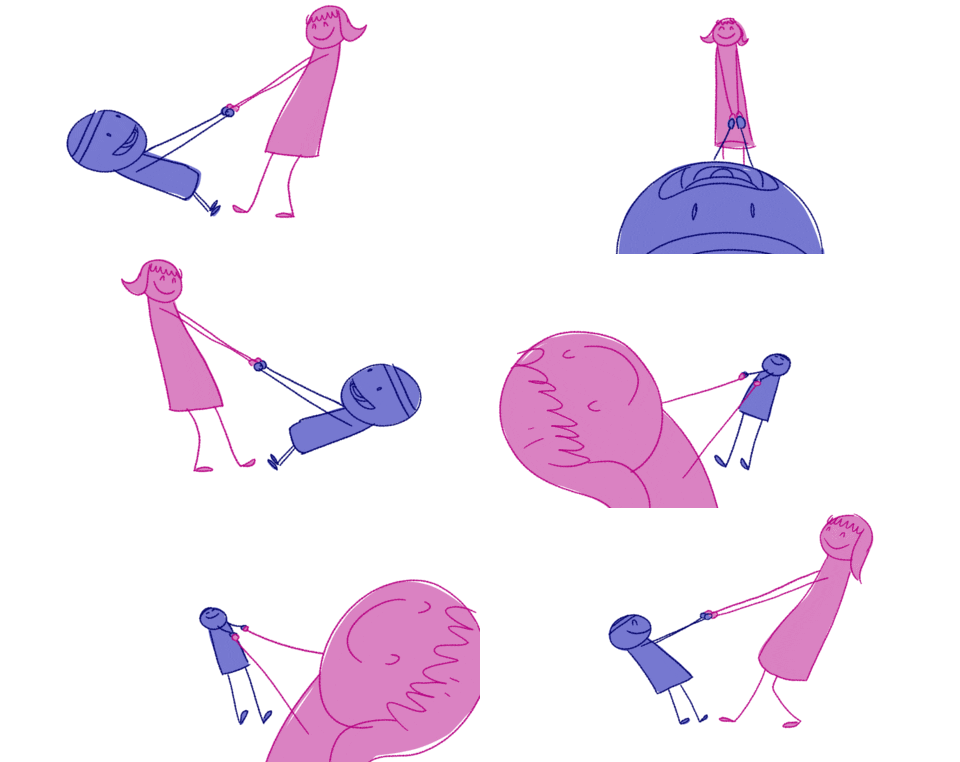
At the end of the course, you can draw your own diagram of how to care for your sleepiness. Include the most obvious signs of drowsiness, triggering scenarios, helpful tips you've already used, and areas where you need to seek further professional support. Please see that you're not fighting against yourself, but learning to care for your body more safely and gently. Drawing is not the end, but a beginning: from seeing yourself, to gradually accompanying yourself towards a more stable life.
Please log in before submitting your drawings and feelings.

○ Diary Healing Suggestions
Today's log is a summary of this series of lessons on excessive sleepiness. Write down your most bothersome symptoms, the most common triggers, helpful tips you've already tried, risks that still require professional evaluation, and the minimum action to take next. Please see that you're not being lazy or deliberately procrastinating; you're learning to care for your wakefulness and rest more safely and gently. Finally, remind yourself: if excessive sleepiness continues to affect your safety, studies, work, or mood, please continue to seek professional support.
Please log in to use.
May you gradually return to a more stable, clear-headed, and gentler version of yourself through today's practice.
This unit's comprehension test
After completing the lesson's main topic, you can access the corresponding lesson's comprehension test here.