

Lesson 31: Will I be anxious for the rest of my life? — Reconstructing the self-narrative of a chronically anxious person
Duration:70 minutes
Topic Introduction:
When anxiety persists for years or even decades, it's easy to conclude, "This is who I am," or "I'll never escape it." This self-narrative can make you ignore the changes that have already occurred and deprive you of any room for imagination about the future. This course doesn't promise to "completely eliminate anxiety," but rather guides you to rewrite your own story: from "a person controlled by anxiety" to "a person with a sensitive nervous system who can still live a life of choices."
○ Key Points of Chronic Anxiety and Self-Narrative
- From "Identity Labels" to "Experience Descriptions":Rewrite "I am an anxious person" as "I have had many anxious experiences", changing the anxiety from "who I am" to "what I have encountered".
- See your survival skills:People with chronic anxiety often develop exceptional predictive abilities, a strong sense of responsibility, and a keen awareness of risk; however, they still need to learn how to use these qualities more gently.
- Distinguishing between constitution and destiny:A sensitive nervous system is a physical predisposition, but it doesn't mean your life must be constantly dominated by anxiety.
- Rearrange the key points in your life story:It no longer only records moments of collapse, but also every adjustment, request for help, perseverance, and repair.
- Allowing "life with anxiety":The goal isn't zero anxiety, but rather that even with fluctuations, you can still work, love, rest, and experience life.
Lesson 31: Am I destined to be anxious my whole life? — Reconstructing the self-narrative of a chronically anxious person 🎧 Click to watch/listen to the reading
People with chronic anxiety almost always ask themselves a heavy question at some point: "Will I be like this for the rest of my life?" This thought itself is often more despairing than the anxiety symptoms. It projects the present pain onto an endless timeline, making one feel that the future has already been predetermined. This question is so powerful because it doesn't ask for facts, but tells a story. The core narrative of this story is: **anxiety is my nature, not my state.** Once you accept this narrative, every discomfort is taken as evidence that "I really am this kind of person." The first step in reconstructing one's self-narrative is to distinguish between "long-term" and "unchanging." Anxiety can last a long time, but that doesn't mean it won't change. In fact, the experience of chronic anxiety is often phased: varying in intensity, form, and scope of impact. To describe it as "for the rest of my life" is a catastrophic narrative of time.
The second step is to detach "I" from the symptoms. You can try stating it like this: "I am experiencing chronic anxiety, not that I am an anxious person." Language is not just rhetoric; it directly influences how you understand yourself. When anxiety transforms from an identity label into an experience, you reserve space for change.
The third step is to rewrite the timeline. Instead of asking "Will it last forever?", ask "How might my future self differ from my present self?" You don't need to guarantee a complete recovery; you just need to acknowledge the possibility of change. Even a decrease in anxiety intensity, a faster recovery, or an expanded life scope are all rewriting of the narrative.
Finally, introduce "non-anxiety evidence" into your self-narrative. Even in the most difficult phases, there are moments when you cope, adjust, and move on. Incorporate these moments into your personal story, rather than just recording the parts that spiral out of control; this will make your overall narrative more complete. Your life is not a straight line defined by anxiety, but a journey of constant adjustment. Anxiety may recur, but it doesn't define your entire life. When you begin to rebuild your self-narrative, the question is no longer "Will I be anxious my whole life?" but "How can I navigate my path with anxiety?"
▲ AI Interaction: If you've been anxious for many years
Perhaps you've gotten used to defining yourself as "the person who's always anxious."
You might think, "Everyone else has made it out, but I'm still stuck in the same place."“
But the reality is often more complex: you are under intense internal pressure while still trying to make a living.
This is not a failure, but a long-term commitment.
What we need to do now is not to deny your past pain, but to try to give these experiences a new meaning.
Click the button below to revisit your anxiety story with AI and try to find new chapter titles for it.
For people with chronic anxiety, music can sometimes act as a "narration" in their lives.
It doesn't need to convince you to be optimistic; it just accompanies you through the ups and downs.
In music, you can temporarily refrain from playing any role, from explaining or proving anything, and simply exist quietly as someone experiencing it.
When a melody ends, you may find that the story continues, and you are still writing within it.
○ Eastern Healing Tea - Longjing Tea (Light Type)
Recommended drinks:Longjing tea (lightly brewed)
Recommended reasons:Longjing tea has a refreshing aroma and a mild stimulating effect without being overly stimulating. It is suitable for people with chronic anxiety to drink when organizing their thoughts and narratives, so as to make their thinking clearer without excessively increasing their tension.
practice:Take 3 grams of Longjing tea, gently pour warm water (around 80℃) along the side of the cup, steep for 1-2 minutes, and then drink. It is recommended to sip slowly while writing or reflecting on your own story, allowing space for new narratives.
○ Quinoa Rainbow Salad (Three-Color Quinoa Salad)
Quinoa provides high-quality protein and minerals, and when paired with bell peppers, cucumbers, cherry tomatoes, and a touch of nuts, it's seasoned with olive oil and lemon juice. Colorful foods can visually and gustatoryly remind you that life isn't just about anxiety, and that your life story can have many more layers.
Color Therapy
Light and refreshing
/home2/lzxwhemy/public_html/arttao_org/wp-content/uploads/cookbook1/tricolor-quinoa-veggie-salad-23.html○ Modern Calligraphy · Lesson 31 Writing Exercises
In-depth analysis:
People with chronic anxiety are often plagued by a heavy question: "Will I be like this for the rest of my life?"“
This issue is not a matter of fact, but rather a construct shaped by anxiety.Self-narrative——
Mistaking one's current state for one's entire destiny.
Modern calligraphy does not pursue uniformity, standardization, or "correct writing".
It allows for breaks, pauses, changes, and the presence of personal traces.
Just like life itself, it is not a straight, single line.
The writing exercises in this lesson are designed to train the brain to express the idea that "I am currently anxious".
Completely break away from the idea that "this is all I can do in my life".
What you are experiencing is just a chapter, not the ending.
Writing Skills (Advanced Version):
- Irregularities are allowed:The height and thickness of the letters can be freely varied, symbolizing that life is not a single track.
- Deliberately breaking the pen:Pausing between words breaks the sense of destiny of "going all the way to the end in one breath".
- The pressure changes are significant:The coexistence of heavy and light strokes represents varying degrees of emotion, rather than a constant one.
- Line spacing does not need to be aligned:The story can have different stages and paces.
- Repeat the writing:Gradually weaken the absolute narrative of "I will always be like this".
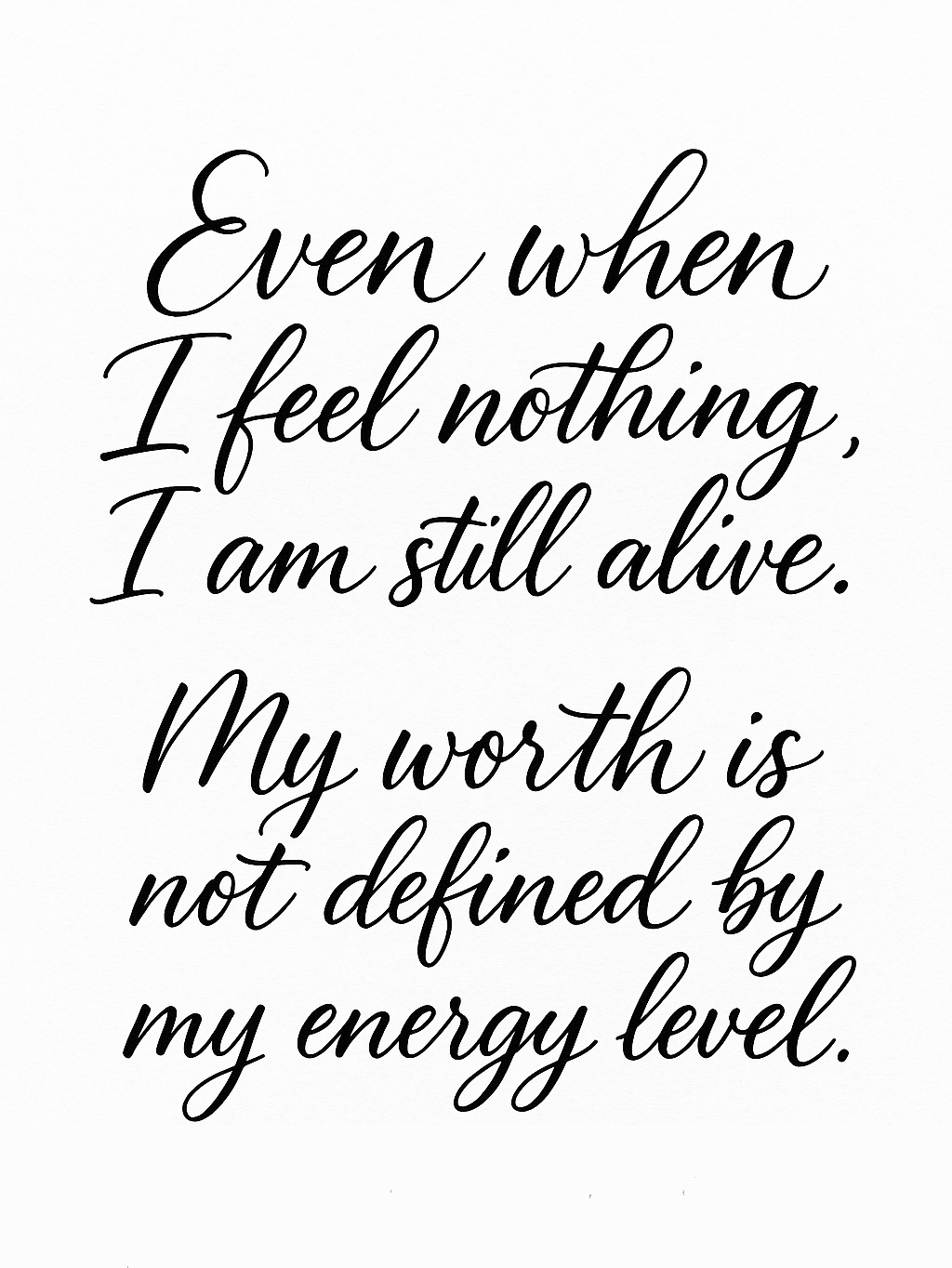
Image Healing: Mandala Stability Guidance 31
Imagine your life as a multi-layered mandala: the innermost layer is your life force, the middle layer is your personality and sensitivities, and the outermost layer is the anxiety, stress, and challenges you've experienced. Now, add a new ring of patterns to the outermost layer, symbolizing the coping mechanisms and support resources you are learning. As you gaze at this image, silently repeat, "Anxiety is just one part, not the whole." Let your gaze slowly return from the outer ring to the center, and feel: you are always broader than your symptoms suggest.
Mandalas help us see that even if a part occupies our field of vision for a long time, the whole still exists. You are trying to shift from "seeing only anxiety" to "seeing the whole self".
◉ Please stare and watch twice.

Lesson 31: Redraw Your Life Timeline
Objective: To help people with chronic anxiety move beyond simply remembering their "history of breakdown" and rediscover the growth, choices, and resources they encountered along the way.
Steps: Draw a horizontal timeline on a piece of paper, starting from a time when you remember yourself most vividly and continuing to the present. Use one color to mark the "stages of heightened anxiety," and another color to mark the "efforts and significant turning points you made" (seeking help, moving, ending a relationship, starting a job, learning a stabilizing skill, etc.). Finally, leave a blank space at the right end of the timeline and write down three keywords you hope will emerge in the next few years (e.g., more stable, more outspoken, less self-blaming) as the direction for your new story.
Please log in before submitting your drawings and feelings.
○ 31. Suggestions for Guiding Self-Narrative Reconstruction Journals
① Write down a few sentences about your usual self-definition, such as: "I am a very anxious person."
② Think about and write down three impacts of this definition on you (including limitations and protections).
③ List three facts that demonstrate that “I am not only anxious” (e.g., I have accomplished something difficult, someone trusts me, or I have taken care of someone).
④ Write a new narrative sentence for yourself, such as: "I am a sensitive person, but I am learning to cooperate with this sensitivity instead of being controlled by it."“
⑤ Record a small thing you did today for this "new narrative" (even if it's just writing these words, eating a meal on time, or refusing an excessive request).
⑥ Write down a modest expectation for the coming year, rather than an absolute goal.
Please log in to use.
Anxiety won't erase your entire life; it will only make certain chapters stand out. May you begin today to slowly put down your pen and rewrite your own story.