

Lesson 192: Different Fear Mechanisms in Enclosed and Open Spaces
Duration:70 minutes
Topic Introduction:
The neural mechanisms underlying the fear evoked by enclosed spaces (elevators, subway cars, narrow staircases) and open spaces (large shopping malls, squares, spacious halls) are not the same.
The former usually triggers the fear of "losing an escape route", while the latter easily evokes a sense of instability of "lack of boundaries and nowhere to settle down".
This lesson helps you distinguish the root causes of these two types of fear, making exposure training more precise and effective.
○ Comparison of the triggering mechanisms of two types of spatial phobia
- ① Enclosed space:Limited exits, poor air circulation, and high spatial pressure create the illusion that "I cannot leave," strongly triggering the panic system.
- ② Ample space:An excessively large visual field, blurred boundaries, and scattered sounds can create a sense of instability, making one feel "unable to control the environment," and may lead to feelings of floating or a feeling of emptiness underfoot.
- ③ Body memory involvement:Enclosed spaces are more likely to cause chest tightness and shortness of breath; open spaces are more likely to cause lightheadedness and imbalance. Because the mechanisms are different, training methods need to be adjusted accordingly.
Lesson 192: Different Fear Mechanisms in Enclosed and Open Spaces (Click to listen to the reading and view the content)
In experiencing spatial anxiety, many people find themselves fearing both enclosed spaces and overly open environments. This seemingly contradictory fear stems from two completely different fear mechanisms. The core of fear in enclosed spaces lies in the feeling of being trapped; it activates the expectation of being unable to escape and losing control. For example, in elevators, small rooms, or train carriages, when the exit is perceived as limited, the brain quickly amplifies imagining suffocation, fainting, or loss of control. Fear in open spaces, on the other hand, arises from a loss of boundaries. For example, in plazas, bridges, open roads, the wider the field of vision, the easier it is to trigger feelings of disorientation, exposure, and lack of support. These two fears are not contradictory but rather different imbalances surrounding the sense of control: one is too few exits, the other too few reference points. When you are in an enclosed space, your brain constantly scans for exits; in an open space, it constantly searches for attachment points. When these two mechanisms are confused, recovery becomes difficult because you may be using the same strategy to deal with different systems. The first step in understanding the differences is to identify which mechanism is currently being triggered. In enclosed spaces, the focus is not on expanding the space but on restoring a sense of choice—for example, confirming that a door can be opened and there is a route to retreat. In open spaces, the focus is not on narrowing the field of vision but on establishing anchor points—for example, fixing the point of visual focus, providing physical support, or clarifying direction. The second key is to avoid confronting two fears simultaneously. For example, don't practice in a tall, open, and enclosed environment all at once; instead, address them separately. The third point is to reassure different systems using different languages. In enclosed spaces, repeatedly convey the message "I can leave," while in open spaces, repeatedly convey "I have support." It's important to understand that fear isn't a problem with the space itself, but rather with the brain losing its familiar regulatory mechanisms under different spatial conditions. When you begin to differentiate and practice specifically, your nervous system will gradually regain its resilience and no longer rely on extreme alarms to maintain safety. True stability isn't about all spaces being the same, but about knowing how to be at peace with yourself in different spaces.
○ AI Interaction: Which type of fear do you lean towards?
Click to interact and answer three questions: "Which is harder for me, a closed or a vast space?"“
“"Where do I get nervous first?" "What am I most worried about that I can't control?"”
The system will identify your individual fear type and suggest the next appropriate exposure direction.
○ Voice Exercises: Helping the Body Rediscover its "Internal Boundaries"“
Regardless of the type of spatial phobia, 3 minutes of low-frequency steady-state sound can help the nervous system establish a sense of boundaries.
The rhythm in a sound is like an "internal ground," giving you a reliable reference point before intense stimulation.
○ Western Herbal Healing Tea - Citrus Blossom Tea
Recommended drinks:Orange Blossom Tea
Recommended reasons:It has a gentle calming effect, relieving palpitations and nervous tension, and bringing an orchard-like tranquility.
practice:Steep 3 grams of dried citrus flowers in 90℃ hot water for 5 minutes.
○ Herbed Olive Rice (ID192)
During the process of dealing with spatial disorientation, the body needs a neutral and stable nourishment. Herb and olive rice uses familiar grains as a base, with olives and herbs providing a clear yet non-irritating flavor. This nourishing dish is suitable for consumption after spatial exercises to help the body return to a balanced state that is neither contracted nor expanded.
vast space
Boundary restoration
Open Recipe
◉ Greece – Mediterranean Diet: Herbed Olive Rice (ID 192)
This is a simple yet soul-stirring rice dish. Unlike ordinary white rice, it incorporates the black gem of the Mediterranean—Kalamata olives—along with plenty of lemon and herbs. For those who feel tasteless due to stress or have no appetite for greasy food, this dish offers a refreshing, clean, and unforgettable dining experience through its natural saltiness and herbal aromas.
Appetizing and refreshing Antioxidant Carbohydrate soothing
I. Recommended Dietary Therapy and Reasons
Recommended dishes:Greek Olive Pilaf
Recommended reasons:
1. Brain protectants:Kalamata olives are rich in hydroxytyrosol, a powerful polyphenol that protects brain cells from oxidative stress and improves cognitive function.
2. Aromatherapy:The volatile essential oils of dill and peppermint have natural calming and antispasmodic properties, which can soothe stomach pain caused by tension.
3. Comfort and Energy:Rice, as a low-allergenic carbohydrate, can quickly raise blood sugar levels, promote the secretion of serotonin in the brain, and bring a sense of emotional comfort (Comfort Food).
2. Recipe and Method
Recipe (Serves 2–3):
- 1 cup long-grain jasmine rice (washed and drained)
- Kalamata black olives (pitted and sliced) 1/2 cup (the key ingredient)
- 1 onion (finely diced)
- 2 tablespoons extra virgin olive oil
- 2 cups of vegetable broth or water
- Fresh dill, 1 large handful (chopped)
- A small bunch of fresh mint leaves (chopped)
- Two scallions (cut into rings)
- Lemon juice from 1/2 lemon
practice:
- Sauté the base ingredients until fragrant:Heat olive oil in a pan, add diced onions, and sauté over medium heat for 5–8 minutes, until the onions are soft, translucent, and release their sweetness.
- Rice grains coated in oil:Add the drained uncooked rice and stir-fry with the onions for 2 minutes. Coat each grain of rice with oil until it becomes translucent. This step ensures the cooked rice is separate and distinct.
- Cooking rice:Add olive slices, water (or broth), and a pinch of salt (note that olives are already salty, so add salt sparingly). Bring to a boil over high heat, then cover and simmer over the lowest heat for 15 minutes.
- Stir-fried:Turn off the heat.Do not lift the lid!Let the rice simmer for another 10 minutes using the residual heat.
- Mixed with the soul:Uncover the pot and pour in lemon juice, chopped dill, mint, and scallions. Gently break up the rice with a fork to mix in the herbs. The aroma will then fill the air.
3. Small rituals for body and mind
Black and white vision:Observe the contrast between the white rice grains and the deep purple-black olives in the rice. This strong visual contrast can stimulate the brain's attention. Tell yourself, "Just like this bowl of rice, the 'black' (difficulties) in life can also be a source of flavor."“
Take a deep breath of the aroma:As you finally stir in the herbs, steam rises carrying the refreshing scents of lemon and dill. Close your eyes, take a deep breath of this "green air," and imagine it cleansing the impurities from your body.
4. Dietary Therapy Experience Record
- Record the sensation of that salty, savory juice bursting in your mouth when you bite into the olive flesh—does it instantly invigorate you?
- After eating, pay attention to whether your stomach feels warm and comfortable, and whether you feel drowsy after eating something greasy.
- Observe whether the sour taste of lemon makes the otherwise bland rice more vibrant, just like adding a highlight to an ordinary day.
V. Instructional Videos (approximately 3–5 minutes)
◉ Video Title:You can eat three bowls of Greek olive and herb rice without any side dishes.
6. Precautions
- Olive selection:Please be sure to use Greek **Kalamata** olives (usually dark purple, soaked in a brine). Do not use the tasteless canned sliced black olives found on pizzas; the flavor is completely different.
- Vanilla timing:Dill and mint must be addedAfter the rice is cooked and the heat is turned offAdd it later. If you add it too early or cook it for too long, the color will turn yellow and the aroma will be completely lost.
- Styling suggestions:This dish can be enjoyed on its own or served as a perfect accompaniment to Lesson 186, "Mediterranean Roasted Chicken," or Lesson 182, "Roasted Sea Bass."
hint:This is a minimalist dish. When your world feels complicated and chaotic, make a simple bowl of rice like this and return to the most basic enjoyment of taste.
○ Suggestions for Chinese Calligraphy and Seal Carving Practice - Lesson 192
The core of this seal carving exercise is to help you regain your inner stability amidst the tension and expansion of space. Whether the seal carving is compressed or stretched out, it requires you to return to the present moment and make that final cut.
- Introduction to the characteristics of seal carving:
This lesson emphasizes the importance of maintaining a fixed direction and preserving momentum. Keeping the blade's direction unchanged after it enters the stone surface, regardless of external perception, symbolizes maintaining control in different spaces. - Writing words and seals:
Shunde Wenshi - Psychological Intention:
The essence of Shunde Wenshi lies in training people to adapt to different environments without losing their own foundation, allowing their sense of security to come from inner order. - Knife skills:
Practice steady, deliberate movements, ensuring each cut corresponds to the starting and ending points, and developing the ability to position the cut within spatial changes. - Emotional transformation:
Transform the fear of space into trust in the rhythm of movement.

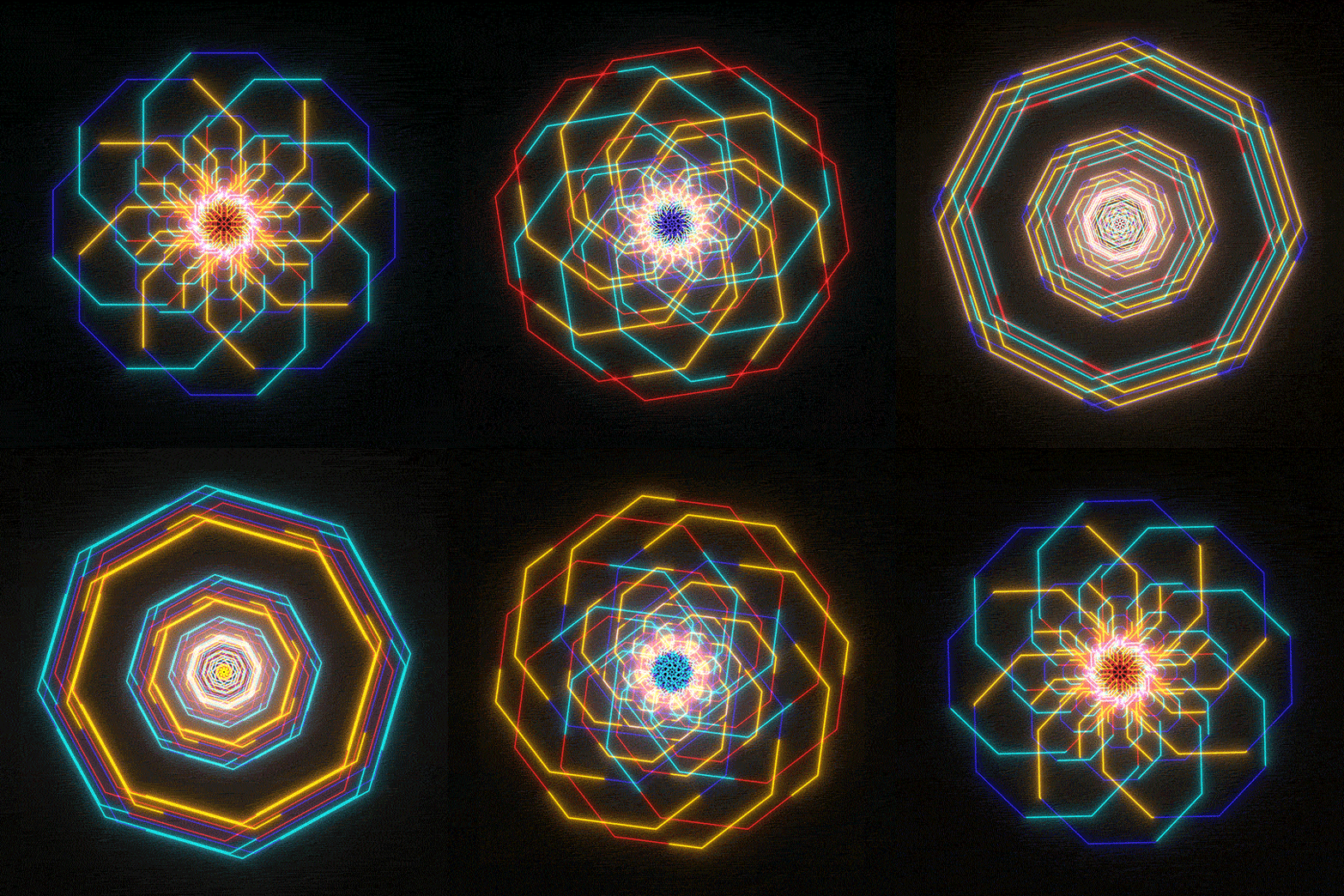
Image Healing: Guided Mandala Viewing - Lesson 192
Choose a mandala that has both an inner and outer ring structure.
Let your gaze move slowly between contraction and expansion.
The feeling is that no matter how the space changes, the center always exists.
Mandala is not about drawing something, but about observing what you are doing and practicing self-placement in different spaces.
The theme of this mandala is the balance between inner and outer, symbolizing that changes in space are no longer synonymous with danger.
◉ One gaze is sufficient; no repetition is required.
Lesson 192: Drawing Your Closed-Open Space Mental Map
① Description of a sense of enclosure:
Draw a small square or narrow rectangle on a piece of paper to symbolize the enclosed space that makes you most tense. Write down the first three reactions your body exhibits.
Symptoms include chest tightness, shallow breathing, and stiff shoulders. Make it clear to yourself that fear is not the "entire space," but rather your body's reaction to certain factors.
② Depiction of vastness:
On the other side, draw a wide circle or an empty scene to represent the open area that makes you uneasy. Mark the elements that evoke a sense of instability.
For example, excessive light, a wide field of vision, or chaotic sound. Draw 2-3 lines to represent the directions in which you are likely to "lose your bearings".
③ Central stable point:
Draw a small circle between the two shapes to symbolize the "inner boundary." Write down three things that immediately stabilize you, such as the weight of your feet,
My own breathing, or the warmth of my palms. Let the image convey: the external space may differ, but I can always return to the center.
Please log in before submitting your drawings and feelings.
○ 192. Spatial Mechanisms - Log Guidance
- Was the space that made me most uncomfortable today enclosed or spacious? What triggered it?
- What are the first three parts of the body to react? On what scale (0–10)?
- What is the next minimal training I would be willing to arrange for myself?
Please log in to use.
Enclosed spaces and open spaces trigger different fear mechanisms, but you can learn to establish your own inner boundaries in any space.