

Lesson 213: Overly Focused on Others' Whereabouts and Responses
Duration:70 minutes
Topic Introduction:When you constantly refresh someone's messages, worry about whether they're online, how long it takes for them to reply, and when they appear, it's not just overthinking; it's a fluctuation in your sense of psychological security. This lesson will guide you to understand the attachment mechanisms and sources of fear behind this behavior, and teach you how to establish healthy boundaries and focus on yourself.
Why do we pay excessive attention to other people's whereabouts and responses?
- Fear of being ignored or abandoned:If the other person is 10 minutes late, the brain automatically interprets it as "Does this mean I'm disliked?"
- Insufficient inner certainty:You need to check whether the other person is online or not to reassure yourself.
- Triggers of past relationship trauma:Past neglect, infidelity, or unstable relationships have made you unusually vigilant.
Lesson 213: Overly Focused on Others' Whereabouts and Responses (Click to listen to the reading, view the content)
Excessive focus on others' whereabouts and responses often stems from a lack of inner security. When relationships are seen as the primary source of emotional stability, attention unconsciously shifts outward. You might frequently check if the other person is online, replying, or has changed their schedule. This constant tracking brings a sense of control in the short term but depletes your ability to maintain stability in the long run. The first layer of the psychological mechanism is external monitoring. When security is outsourced to others, any unpredictable changes are interpreted as risk signals. The second layer is meaning filling. The other person's silence or delay is quickly given a negative interpretation, amplifying anxiety. The third layer is behavioral reinforcement. Each check acts like a micro-dose of reassurance, leading the brain to mistakenly believe that monitoring is effective, thus forming a habitual loop. The key to understanding this pattern is to shift focus from others' trajectories back to your own rhythm. The first step is awareness of triggers. Identify which situations are most likely to trigger the tracking impulse, such as waiting for a reply, nearing separation, or during periods of fatigue. The second key point is setting a window. Set fixed times for checking behavior instead of letting it happen at any time, allowing the nervous system to learn to wait. The third stage is substituting anchors. When the impulse arises, turn to physical anchors, such as the ground, breathing rhythm, or a short walk, replacing imagination with tangible reality. The fourth key is reconstructing evidence. Recording the fact that the relationship continues even without being checked helps the brain update its model. It's important to understand that attention isn't everything; true care includes respecting each other's pace. As you gradually reduce external monitoring and strengthen internal support, tension in the relationship will naturally decrease. True security isn't about knowing where others are, but about trusting that the connection and the self can function independently. When attention returns to oneself, life unfolds anew, and the relationship gains breathing space.
▲ AI Interaction: What's on your mind while you're waiting for a message?
When you're staring at your phone waiting for a reply, your body is already in a state of alert.
A racing heart, sweaty palms, and growing tension—this is not "simple waiting."
It's more like a way of saying, "I'm confirming whether I'm needed."
Try asking yourself: Am I waiting for news, or am I waiting for a feeling of affirmation?
Gradually shift your focus from "what the other person is doing" back to "how I am feeling right now".
Click the button below to practice with AI how to "return from the state of others to your own inner feelings".
When anxious, the brain automatically seeks out "risks".
Try playing some soft music and let the rhythm help you relax and breathe.
The steady rhythm of the music reminds the body that there is no danger at this moment.
When you slow down your mind and body, you'll find that your obsession with news also loosens.
○ Eastern Healing Tea: Osmanthus and Red Date Tea
Recommended drinks:Osmanthus and Red Date Tea
Recommended reasons:It has a calming effect, warms the stomach, and relieves palpitations, helping to reduce tension while waiting for news.
practice:Slice 3-4 red dates, add a little osmanthus, and soak in hot water for 5 minutes.
○ Stable Dietary Therapy: Glehnia Ophiopogon Porridge (ID213)
During the adjustment phase of external monitoring and internal regression, the body needs nourishing and moisturizing support. The presence of Bei Sha (a type of herb) and Ophiopogon japonicus helps alleviate internal dryness, symbolizing the return of attention from the outside in. This dietary approach is suitable for consumption after reducing visual activity to help the nervous system complete its recovery.
Please pay attention to recycling.
Relationship Boundaries
Open Recipe
◉ Chinese Dietary Therapy: Glehnia and Ophiopogon Porridge (ID 213)
Traditional Chinese medicine often compares "Adenophora stricta" and "Ophiopogon japonicus" to "two clear springs" that nourish the body. Prolonged stress and anxiety can generate internal heat, which can deplete the body's fluids (Yin deficiency), leaving one feeling dry and irritable. This porridge is specifically designed for "Lung and Stomach Yin deficiency." It is neither cold nor hot in nature, but rather gentle and nourishing, gradually replenishing lost moisture and Yin fluids, and extinguishing the internal heat.
Nourishes yin and promotes fluid production Clear heat and relieve irritability Moisturizes and relieves cough
I. Recommended Dietary Therapy and Reasons
Recommended dishes:Glehnia & Ophiopogon Porridge for Moistening Dryness
Recommended reasons:
1. Deep hydration:Ordinary water can only quench thirst, but sand ginseng and ophiopogon japonicus can quench "body thirst." They can promote the production of body fluids and relieve persistent dry mouth, dry throat, and dry skin caused by yin deficiency.
2. Soothe feverishness:People with Yin deficiency often experience "five-center heat" (hot palms and soles, and irritability). Ophiopogon japonicus has a slightly cooling property, which can clear and nourish the Yin of the heart and eliminate that feeling of restlessness and irritability.
3. Repairing the gastric mucosa:For those experiencing dull stomach pain and hunger without appetite (hunger without appetite) caused by insufficient stomach yin, this porridge can nourish the stomach meridians and restore appetite.
2. Recipe and Method
Recipe (1–2 servings):
- 15g of North American ginseng (available at pharmacies, specifically for nourishing the yin of the lungs and stomach).
- 15g of Ophiopogon japonicus (the key to nourishing yin and promoting body fluid production)
- Rice (japonica rice) 80g
- Rock sugar (appropriate amount)
- 1000ml of clean water
practice:
- Decoction (recommended):The texture of Adenophora stricta and Ophiopogon japonicus is woody, and they don't taste good when eaten directly. Wash the herbs, put them in a pot, add water, bring to a boil over high heat, then simmer over low heat for 20–30 minutes.
- Remove the residue:Filter out the clear medicinal liquid. Discard the dregs (or put them in a non-woven bag and cook them with rice).
- Cooking porridge:Add the washed rice to the medicinal broth (add more water if needed). Bring to a boil over high heat.
- Slow cooking:Simmer over low heat for 30 minutes, until the rice grains have opened up and the porridge has become slightly thick.
- Seasoning:Add rock sugar and stir until dissolved. Traditional Chinese medicine believes that rock sugar itself has a lung-moistening effect, making it a perfect match for this porridge.
3. Small rituals for body and mind
Nectar Contemplation:The broth of this porridge is clear and sweet. When you drink it, close your eyes and imagine this cool nectar flowing down your throat, through your parched lungs and stomach walls, extinguishing the restless flames and restoring tender green vitality wherever it goes.
Moisturizing experience:Feel the smoothness of the porridge with your tongue and tell yourself, "My body is becoming soft and moist again."“
4. Dietary Therapy Experience Record
- Record whether the dryness and itchiness in the throat lessened or the urge to drink water decreased within half an hour after drinking the porridge.
- Observe whether your palms and soles are no longer so hot when you fall asleep that night, and whether you can put your hands and feet under the covers more securely.
- After long-term consumption, observe whether your skin becomes less prone to flaking.
V. Instructional Videos (approximately 3–5 minutes)
◉ Video Title:Dry mouth, irritability, and insomnia? This bowl of "yin-nourishing water" is even more nourishing than a face mask.
6. Precautions
- Foods to avoid when you have a cold due to wind and cold:If you feel cold, have a runny nose with clear mucus, and cough up white phlegm (this indicates a cold syndrome), then you are experiencing these symptoms.Do not eatAdenophora stricta and Ophiopogon japonicus. They are slightly cold in nature and can aggravate coldness.
- Use with caution if you have high humidity levels:If you have a thick, greasy tongue coating, loose stools, and excessive phlegm and dampness, yin-nourishing medications may be too rich and greasy, and may cause dampness to accumulate. It is recommended to switch to the lentil and barley porridge from Lesson 204.
- Selection of medicinal materials:There are two types of Adenophora stricta: "Southern Adenophora" and "Northern Adenophora". It is often used to nourish the Yin of the lungs and stomach.North American ginsengFor expectorant and cough suppressant purposes, use South American ginseng. For daily maintenance, it is recommended to buy North American ginseng.
hint:This is a "repairing porridge" that is perfect for the dry autumn season or for those who have stayed up late working overtime.
○ Suggestions for Modern Calligraphy Writing Practice
The topic of this lesson:Shift your attention from external trajectories back to your own rhythm
In-depth analysis:
Excessive focus on the whereabouts of others is essentially a result of your attention being constantly drawn away.
Modern art calligraphy emphasizes the return to rhythm and the autonomy of lines, making it very suitable for training and paying attention to retraction.
When you let the lines move in accordance with your own breath instead of chasing external forms, the brain learns: I can decide where to focus.
The writing process is an experiential exercise that moves from tracking back to returning to the source.
Writing tips (note the recycled version):
- BreathSync:Each inhale, each stroke, each exhale, each pause allows the brushstrokes to follow their own rhythm.
- CenterReturn:After completing each character, return to the center to practice writing, being careful not to be pulled away.
- Slow Closure:Deliberately slowing down the pace of the movement symbolizes not overreacting to external changes.
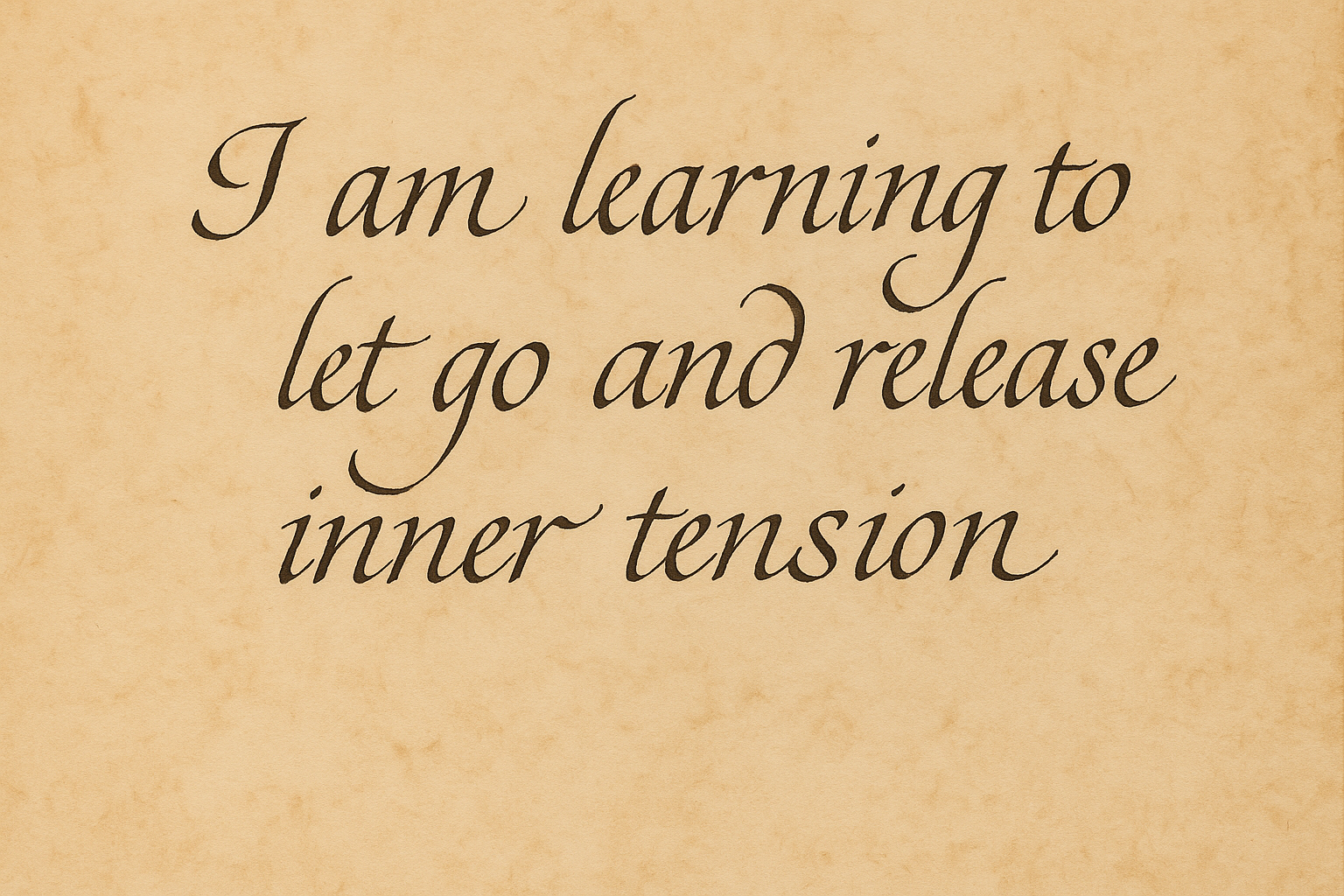
Image Healing: Guided Mandala Viewing - Lesson 213
Choose a mandala with a clear center and simple path.
Guide your gaze along the path to the center and let it linger.
Feel your attention settled and not scattered.
Mandala is not about drawing something, but about observing. In observing, you practice regeneration and tranquility.
The theme of this lesson's mandala is the circle of returning to the heart, symbolizing focusing on returning to oneself.
◉ One gaze is sufficient; no repetition is required.

Lesson 213: Emotional Images of Waiting for Messages
Objective: To visualize the tension of "waiting for news," allowing the brain to shift from abstract fear to an observable image.
Steps: Draw a glowing phone icon, representing your current focus. Next, draw the distance between yourself and the phone—are you very close, or almost touching it? Add color to the drawing: use red to express anxiety, gray-blue to represent fatigue, and green to represent the stability of hope. Finally, draw a symbol in the corner of the drawing that "represents your center" (such as a small circle or flame), symbolizing your willingness to refocus your attention on yourself.
Please log in before submitting your drawings and feelings.
○ 213. Journaling guidance suggestions for anxiety while waiting for a response
① In what situation today are you most looking forward to the other person's response? Record the time and your emotions.
② Observe the body's reactions while waiting: heart rate, hand and foot temperature, and thoughts in the mind.
③ Which thought makes you most anxious? (e.g., "Did I do something wrong?")
④ Write down one "alternative explanation" to help slow down, such as "the other person may be busy".
⑤ Record an experience where you pulled your attention away from your phone and back to life: Occurrence → Practice → Result.
⑥ In which scenario would you like to practice "reducing the frequency of checking" tomorrow? What are the criteria for success?
Please log in to use.
The person who can truly give you a sense of security is yourself. Shift your focus from "where is he/she" back to "what I am feeling," and you'll find your heart becomes freer and more at peace.