

Lesson 1356: Stimulus Control Method (CBT-I)
Duration:75 minutes
Topic Introduction:
Stimulus control is the most basic and fastest-improving technique in insomnia treatment. Its core goal is to help the brain relearn that "bed = sleep, not wakefulness." Many insomniacs become more awake the more they lie in bed not because they have poor sleep ability, but because the bed is associated with behaviors such as tension, thinking, work, using their phones, and worry, thus creating a false conditioned reflex in the brain. This lesson will help you understand this mechanism and break it down scientifically: Why must you go to bed when you're sleepy? Why should you get out of bed if you can't sleep? Why shouldn't you daydream, think, be anxious, or look at your phone in bed? Why does it become harder to fall asleep the harder you try?
We will combine the calming bedtime routine of herbal teas, the blood pressure-lowering effects of Ayurvedic spice soups, the visual homeostasis of mandala viewing, and the slow rhythm of medieval Gothic calligraphy practice to help the brain switch from daytime excitement to nighttime rhythms. This stimulation control method not only rebuilds sleep connections but also relearns that the night is a time to stop, not a continuous battlefield of being driven.
[arttao_Healing_Course_tts_group1356]
▲ AI Interaction: Your "Bed = Wake-up" Checklist Analysis
List all the non-sleep-related behaviors you do in bed, send them to AI, and let the system help you determine which behaviors are disrupting your sleep conditioning and provide alternative strategies.
(For example: scrolling on your phone, daydreaming, overthinking, working, eating, watching TV, feeling anxious, etc.)
○ Music Therapy: Nighttime Rhythmic Guided Sounds
Choose low-frequency, slow-paced music (around 50–60 BPM) and play it before lying in bed to help your brain establish a conditioned reflex that "sound = preparing to fall asleep".
- Do not use during the day; keep it for nighttime use only.
- Combine this with deep, long breaths to enhance the feeling of slowing down your body.
- In conjunction with the "get out of bed - return to bed" mode, a steady-state cycle is formed.
○ Herbal Tea Healing Drink: Peppermint + Licorice Stress-Relieving and Sleep-Inducing Tea
Recommended reasons:Suitable for people who experience tension when lying down during the initial stages of stimulation control, it helps reduce sympathetic nerve excitation before falling asleep.
usage:Drink 30–45 minutes before bedtime, and can be combined with neck and shoulder relaxation and hot compress.
○ Ayurvedic Spice Soup/Nighttime Tranquility Soup
Slow-cooking nutmeg, ginger, and fennel helps reduce the digestive burden in the evening, relieves inner anxiety, and makes it easier for the body to enter "nighttime rest mode".
It symbolizes "returning from overdrive to homeostasis" and is a complementary ritual that is very suitable for stimulus control methods.
Restoring the nighttime rhythm
Sleep aid and warming
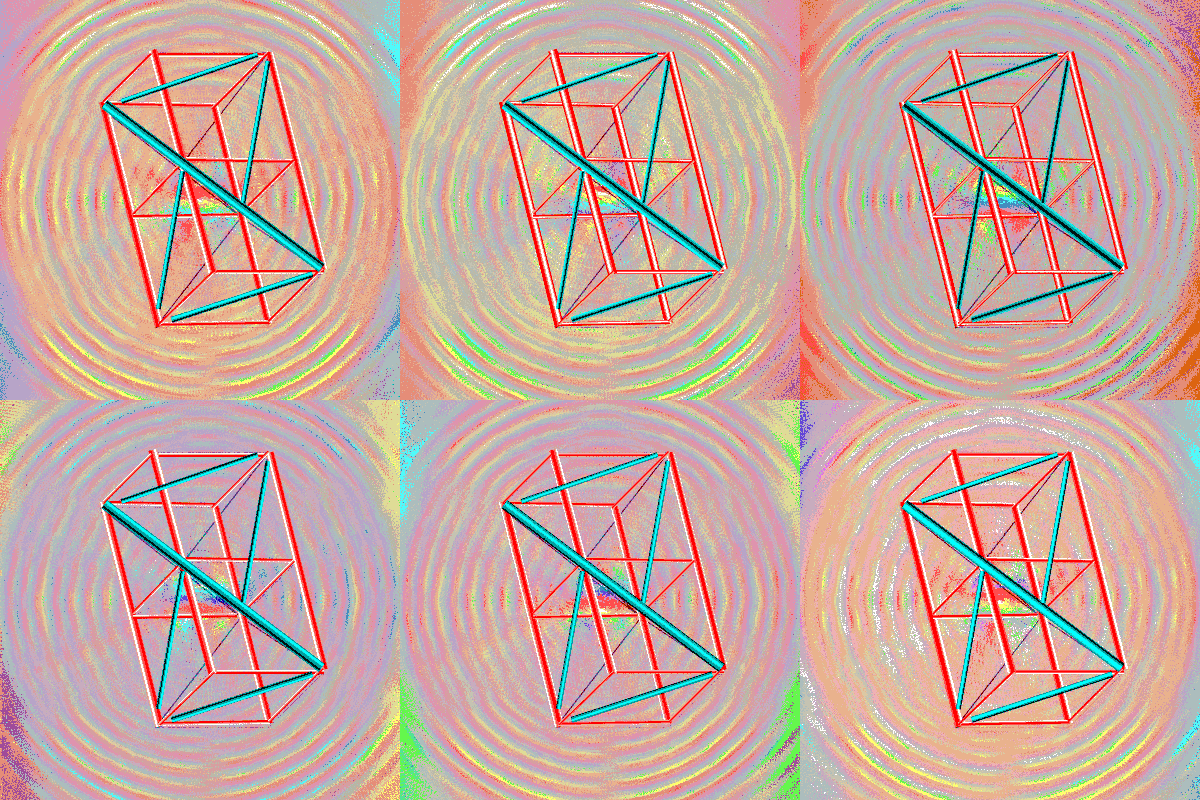
Mental Mandala Viewing Exercise
Psychological Healing: Psychological Mandala Imagery 102
The most painful part of insomnia is that "the more you want to sleep, the more awake you become."
Mandala viewing practice trains a different kind of ability—not through effort or resistance, but by allowing the vision to gradually bring you back to a stable rhythm.
By focusing on the center of the mandala, you will feel the outer circle gradually converge, while your mind gradually moves away from the chase and back towards the stillness of the night.
○ Medieval Gothic calligraphy - Sentence reconstruction of sleep conditioning
Write down a "sleep restoration promise" in slow, deliberate strokes that your brain will remember:
- My bed is for sleeping.
- A bed is for rest, not for anxiety.
- When I lie down, my body slows down.
[spiritual_mandala_v3_575-580]
Lesson 1356: CBT-I (Currently Differentiated Therapy): Guiding Suggestions for Art Therapy
The core of stimulus control is to retrain the brain:Bed = Sleep and RelaxationIt should not be a place for working, scrolling through your phone, daydreaming, or blaming yourself.
This page uses illustrations to clearly depict the connection between "bed and wakefulness" and "bed and drowsiness," helping you gradually break free from the old path of "lying in bed but becoming increasingly awake."
Establish a new route in the image that "the bed is for sleeping." The goal is to visually remind yourself that when I lie back in bed, I am doing a new connection exercise.
I. A Comparison Diagram of the "Two Identities of a Bed"
- Draw a bed on the left and a bed on the right: write "Old Connection" on the left and "New Connection" on the right.
- Draw your real-life usage scenarios on the bed of "old connections": scrolling through your phone, replying to messages, working overtime, watching videos, spacing out anxiously, repeatedly checking the time, etc.
- On the bed in "New Connection," only draw elements related to sleep: closed eyes, quiet, reading a short light book, relaxing breathing, etc., and leave a large clean space.
- Write a phrase below the image: "If I am awake for more than 20 minutes, I get up and leave the bed with only the memory of 'drowsiness'." Remind yourself to practice the core steps of stimulus control.
II. "Sleepiness Path" Flowchart
- Draw a path from the "living room/desk" to the "bed", and mark several nodes on the path: light activity, dimming the lights, turning off the screen, simple stretching, and feeling sleepy.
- Draw a small icon at each node (such as softening the light, closing the book, or moving the phone away) to symbolize that you are training your brain: "This is a fixed route to sleep."
- Draw another "old path" next to the path: connect directly from the bed to the phone, work, worries, etc., and label it with a different color as "old habits, fading away".
- By placing these two paths side by side, you can have a "visual map" to follow in real life, instead of relying on willpower to get through it.
Please log in before submitting your drawings and feelings.
○ 1356. Stimulus Control Method (CBT-I) · Log-Guided Suggestions
① Write down all the non-sleep behaviors you have done in bed in the past.
② How do these behaviors cause the brain to form a "bed = awake" reflex?
③ Which item are you willing to change starting today?
④ Write yourself a new nighttime promise.
Please log in to use.
Stimulus control is not about forcing someone to sleep.
Instead, it teaches the brain to remember again—
The bed is a safe, quiet place that belongs to the night.